
LED Downlights Installation Paddington
Hot halogens, dim rooms or globes that keep blowing? Swapping to LED gives your Paddington home cooler, longer-lasting lights that suit your ceiling.
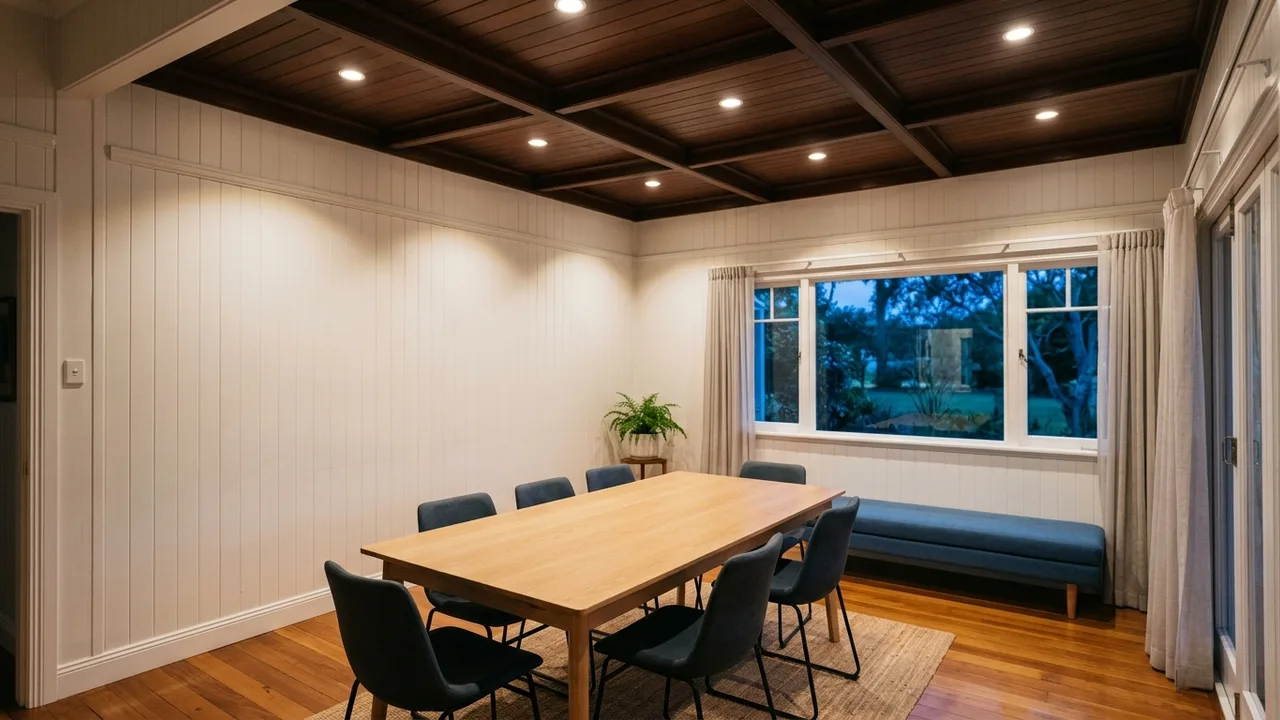
Paddington LED downlights installation is routine work for a licensed electrician, and old halogens can almost always be swapped for LED. In the timber Queenslanders and other older character homes around Paddington, halogens have often been running hot in the ceiling for years. The swap lowers the heat in the ceiling space, trims the power each light draws and usually ends the cycle of globes blowing every few months.
LED downlights installation Paddington: swapping out old halogens
Halogen downlights were the standard choice for years, and plenty of Paddington homes still have a ceiling full of them. Each one runs hot, and many hide a small transformer in the roof space that adds more heat and one more part to fail.
LED downlights do the same job on far less power and stay much cooler. In many cases the new light fits the hole the halogen left, so the ceiling is not cut up again. Where the hole is the wrong size, a different fitting or a trim ring can usually cover it.
The swap is also the moment to fix the layout, so the light lands where you actually use the space.
Electrician Paddington: halogen swaps for older Queenslander homes
Older Queenslander homes often have tight roof spaces, timber framing and wiring that has been added to over decades. A halogen downlight pushing heat into that space is not doing the timber or the cabling any favours.
An electrician who works in these houses plans around the building. That means checking where cables run before cutting, taking care with timber-lined ceilings, and leaving the character of the room intact. High ceilings and VJ boards (the narrow timber lining boards common in Queenslanders) can also change which fitting looks right.
Can LED downlights touch ceiling insulation?
Only if the fitting is made to sit against insulation. Downlights that are not built for that need clear space around them, and packing insulation up against one can trap heat. The electrician can match the type to your ceiling.
Queensland law also limits how installers hold insulation up. Staples and other metal fixings that carry current are off limits for a business and its workers, because one driven through a cable can make the ceiling live.
A good installer keeps insulation clear of the wrong fittings, uses the right ones where it must touch, and leaves the roof space safe.
Recessed or surface-mounted downlights?
Recessed lights sit flush in the ceiling and need a hole plus space above for the fitting and wiring. They give the cleanest look and suit most plasterboard ceilings.
Surface-mounted lights sit on the ceiling face. They suit rooms where the roof space cannot be reached, where a solid or timber ceiling should not be cut, or where a renovation has left no room above.
The choice comes down to what is above your ceiling and how you want the room to look.
Sensor lights, dimmers and feature lighting
Sensor lights earn their place on back steps, side paths, carports and verandahs, where you arrive with full hands and a switch is out of reach. Placement matters, because a sensor aimed at a busy street or a swaying tree will trigger all night.
Dimmers need to suit the lights. Many older dimmers were built for halogens and make LEDs buzz, flicker or fail to dim smoothly. A matched dimmer and LED set avoids that.
Feature lighting such as wall lights or pendants is easiest to add during a swap or renovation, while the ceiling is already being worked on.
Flickering lights and burnt-out globes point to a fault
Flickering and early failures usually trace back to the fitting, the wiring or the circuit. The electrician tests each light's connections, the transformer if there is one, and the load on the circuit before suggesting a fix.
Replacing the globe again only repeats the problem when the cause sits elsewhere.
If the problem sits in the switchboard or the wiring, new LEDs alone will not cure it, and a good electrician will say so.
What affects the cost of a downlight job
The number of lights is the biggest driver, followed by how easy the ceiling is to reach. A single room with open roof access is a very different job from a whole house with a cramped cavity.
The condition of the existing wiring matters too, and so do new dimmers, sensor lights and extra switch points.
A clear price before work starts lets you judge the job properly. Licensed electricians do the installation, and Queensland contractors must give a certificate of testing and compliance when installation work is finished.
Still putting up with hot halogens or lights that flicker? Say how many lights you have and what is above the ceiling, then request help with the swap.
How it works
-
Look at the lights and ceiling
The electrician checks what is there now, how many lights you have and whether the roof space can be reached.
-
Agree the plan and price
Light positions, fitting type and dimmers are settled, and you get a clear price before any wiring is touched.
-
Swap or install the lights
Old halogens and their transformers come out, new fittings go in, and wiring is tidied as the work goes.
-
Test and sign off
Every light and switch is tested, and a certificate of testing and compliance is provided when installation work is finished.
Scope in detail
- Hot, power-hungry halogens Replacing them cools the ceiling space and lightens the load on the circuit.
- Renovated kitchens, bathrooms and living areas Light lands where you work and relax, not where old wiring happened to end.
- Dark verandahs, paths and stairs Sensor lights come on when you arrive with full hands, and a feature light can show off a timber ceiling or a wall.
- Rooms that need more than one mood A dimmer lets one room serve dinner and homework, but it has to suit the lights on it.
- Lights that flicker or keep blowing globes A halogen-era dimmer feeding new LEDs can make them flicker, and swapping it can end the problem.
Lighting and LED downlights options
- LED downlight replacement Halogen fittings out, LED in, sized to the existing holes where possible.
- New downlight installation Fresh circuits and cut-ins for new builds, extensions and renovated rooms.
- Sensor lights Movement-activated lights for entries, carports and back steps.
- Dimmers Dimmer switches matched to the LEDs they control so they do not buzz.
- Flicker and blown globe diagnosis Tracing early failures to old transformers, loose terminals or the circuit.
Lighting and LED downlights across Paddington
Frequently Asked Questions
How long does a downlight installation in Paddington take?
Why do my lights dim when the air conditioner kicks in?
Why do the globes in my downlights burn out so often?
Talk to a specialist
Power out or a switch that keeps tripping? Tell us what is happening and get it sorted.
Share the details and we will help you take the next step with confidence.